Investigating GP Support for Homeless People
Our report explores the challenges homeless people face when registering with a GP and shares recommendations to make healthcare fair and accessible.
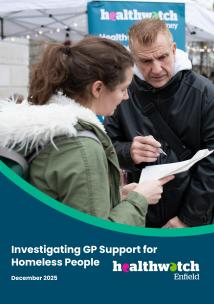
Healthwatch Enfield’s latest report investigates how GP practices in Enfield support people experiencing homelessness with registration and access to care. The study highlights barriers such as lack of ID, stigma, and inconsistent practice policies, and offers practical recommendations to make healthcare fair and accessible for everyone.
Who took part?
-
Between July and August 2025, Healthwatch staff and volunteers contacted all 39 GP practices in Enfield as part of a mystery shopping exercise.
-
From August to November 2025, we interviewed 12 people experiencing homelessness at the All People All Places day centre. The charity All People All Places helped us with outreach and engagement.
"What if they ask for a passport? What if they turn me away because I don’t live in the area?"
Key findings
Current Practice Gaps
- Mystery shopping revealed inconsistent knowledge among GP reception staff about registration rights for homeless individuals.
- Some practices failed to offer reasonable adjustments or maintain confidentiality during registration.
-
Procedures varied widely, and some practices created unnecessary hurdles, such as insisting on documentation or online-only forms.
Examples of Best Practice
- 72% practices contacted, receptionist were professional and supportive over the phone.
- Some practices demonstrated good practice by offering flexible registration options and compassionate communication.
- Practices with dedicated support (i.e. language interpretation service, double appointments) were better equiped to support vulnerable patients.
Barriers to GP Registration
- Homeless individuals are wrongly turned away due to lack of ID or a fixed address, despite NHS guidelines allowing registration without these.
- Stigma and fear of rejection discourage people from seeking care.
- Individuals avoided registering because they believed they needed ID, proof of address, or a British passport.
- People were discharged from previous GPs after becoming homeless and were unsure how to register elsewhere.
- Non-English speakers relied on translation apps or charity support for communication.
- Online-only forms were a barrier for those without devices or internet access.
- Reports of dismissive reception staff and lack of help with forms; breaches of confidentiality when asked to disclose homelessness publicly.
Our findings show that barriers such as ID requirements, lack of staff training, and poor communication are deeply rooted in practice processes. Addressing these issues calls for coordinated action across GP practices, Integrated Care Boards, and community partners.
Our recommendations include:
- Train front desk staff on NHS guidelines, homelessness policy, and trauma-informed care.
- Promote and display clear information about registering with a GP without a fixed address.
- Remove barriers to registration such as requiring proof of address, ID, or online-only forms.
- Improve confidentiality and accessibility at GP practices to protect dignity and privacy.
- Work with charities and outreach programmes (e.g. Medicus Homelessness Programme) to help homeless individuals register.
- Adopt the Doctors of the World Safe Surgery Toolkit to standardise inclusive practices across GP services.
Downloads
Investigating GP Support for Homeless People 2025